Jupiter High Students Have Been Wading Into the Indian River Lagoon to Count Fish Every Month Since 1994 — and the Water Is Getting Better
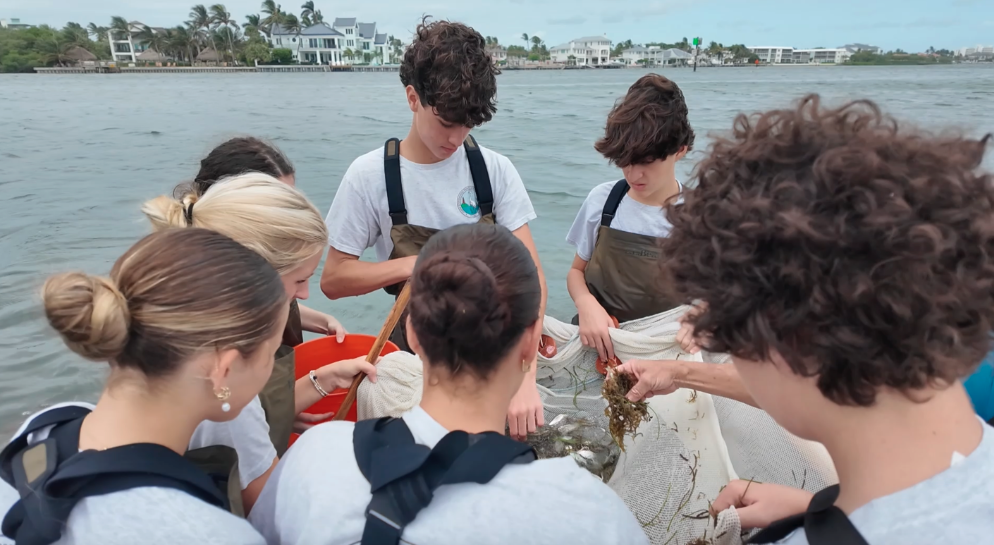
For a group of Jupiter High School students, science class on Thursday meant pulling on waders and heading into the Indian River Lagoon near Jupiter Island with a 55-foot bag seine net.
They were there to count fish.
It's something Jupiter High students have been doing at that same site every month since 1994. The data they collect goes into a long-term study tracking the health of the lagoon — one of the most ecologically significant and historically stressed waterways in Florida.
The work is part of the school's Environmental Research and Field Studies Academy, a four-year program that takes students into the field roughly once a month. On Thursday's survey, students used the seine net to collect juvenile fish, then identified, measured, and recorded each species before releasing them back into the water. Biologist David Porter from the Loxahatchee River Environmental Control District worked alongside the class.
The data the students generate isn't just classroom exercise — it's real scientific recordkeeping at a site that has been continuously studied since the 1970s.
And the numbers are starting to tell a better story.
"In recent years, the seagrasses have been starting to do a little bit better here, and we've noticed that the fish catch has gotten a lot greater," said instructor Aaron Lichtig.
Surveys conducted five to eight years ago produced fewer fish and less species diversity — a reflection of the lagoon's long struggle with algae blooms, nutrient runoff, and seagrass die-off. The recent improvement in both seagrass coverage and fish populations is measurable, and the students are the ones doing the measuring.
For 10th grader Emery Taylor, the experience put classroom concepts into a different perspective.
"Actually being in the environment and then seeing all the different populations and measuring and holding the fish, it was cool," Taylor said.
Lichtig said the field work is often when the learning actually clicks. "A lot of times I don't see it really connect until I have them out in the field," he said. Some students eventually go on to pursue careers in science or environmental science — a path that started, in part, with a Thursday morning in the lagoon.
The Loxahatchee River Environmental Control District assists the academy during fieldwork, providing expert guidance alongside the long-term institutional knowledge of a site that has been watched, documented, and studied for half a century.
Image source: PBCSD/CBS12